The post is a letter to a Math Analysis Honors student in my class next year.
1. What do you want to say to them to help them have the most successful year possible?
Math analysis is very rigorous course in terms that you have to stay on top of things. This class requires you to stay organized, manage your time, and work hard in order to succeed. I know it may seem quite overwhelming in the beginning of the year but honestly it is a very great class to take in order to challenge your management. To have the most successful year I believe that you just must stay on top of your things and get things done on time. If not then you will catch yourself falling behind and not being able to catch back up. It is important that all of you taking this class are prepare for the work load and for the many requirements entailed to pass this class such as the Internet. This class requires you to use your resources like the computer a lot and just everything given to you by Mrs. Kirch herself. It is important mainly as I said before that you remain organized and up to date. Also, and important factor for success is to work hard. You need to be able to put in the work in this class in order to succeed. It won't come to you unless you put in the effort. This is necessary for the entire year, even towards the end when you start getting lazy. Working had and staying on top of things are two of the most important factors that you need to possess for success.
2. How can they best adjust to the flipped classroom and learn to work with all the technology I require of them? (do you have any specific tips for them or experiences you could share?)
Adjusting to the flipped classroom the first few weeks are pretty challenging and difficult but as soon as the year progresses you forget about it. At first I had trouble adjusting to the whole learning at home part but after a while you start to notice how much it actually benefits you because in class you get to ask questions. To adjust to the use of technology and flipped classroom just get used to learning at home and getting a quiet place at home where you can study and complete your online lessons. Also you need to come in knowing how to work the computer and have technology such as the graphing calculator.
3. What can they expect to be different from their previous math classes?
The flipped classroom is nothing like what you may expect from your normal math classes. This is a class where you are challenged by your knowledge in technology, and also your capability of staying focused. This classroom requires you to stay on top of things and not fall behind as you can in other math classes. The work load is also different and the responsibility you take on in this course is also much greater. Responsibility I feel is a factor that is much more entailed for this course because you need to be able manage your time and stay focused, even with all the technology that may distract you.
Thursday, June 6, 2013

Monday, June 3, 2013
Unit V BlG Question Blog Post
Unit V BlG Question Blog Post
1. Explain in detail where the difference quotient comes from.
The difference quotient is derived from a graph in which we are trying to figure out the slope of the tangent line. This slope that we are trying to find of this tangent line is also known as the derivative which is usually shown as f' (x). The difference quotient comes from the point on the graph in which the slope of the tangent line is crossing at. This point is referred to as (x, f(x)). The change of x where another tangent line crosses the graph is known as the change of x (delta x+ x) plus x. The secant line is the place where the line crosses at two points which also helps explain this difference quotient where the second ordered pair is known as (x+deltax, f(x+delta x). After getting these two points you use the slope formula of y2-y1/x2-x1 in order to solve further. When plugging in the values of the ordered pairs you are able to cancel some values and are then left with the difference quotient.
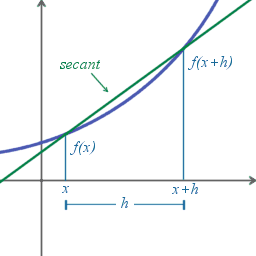
1. Explain in detail where the difference quotient comes from.
The difference quotient is derived from a graph in which we are trying to figure out the slope of the tangent line. This slope that we are trying to find of this tangent line is also known as the derivative which is usually shown as f' (x). The difference quotient comes from the point on the graph in which the slope of the tangent line is crossing at. This point is referred to as (x, f(x)). The change of x where another tangent line crosses the graph is known as the change of x (delta x+ x) plus x. The secant line is the place where the line crosses at two points which also helps explain this difference quotient where the second ordered pair is known as (x+deltax, f(x+delta x). After getting these two points you use the slope formula of y2-y1/x2-x1 in order to solve further. When plugging in the values of the ordered pairs you are able to cancel some values and are then left with the difference quotient.
Citation: http://upload.wikimedia.org/wikipedia/commons/8/8c/Derivative.png
Monday, May 27, 2013
Unit U Blog Post
Unit U Big Questions:
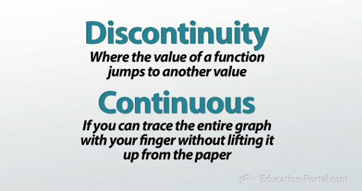
1. Continuity is the state of something being continuous in terms of this unit it has to do with the continuous functions on the graphs that can be drawn without a break between a pencil stroke. Discontinuity is the opposite, this describes a function on the graph which has breaks and cannot be drawn with one stroke of a pencil. On these type of graphs the values jump.
 |
| pic 1 |
 |
| pic 2
Citation:
pic1: http://www.necessaryconclusions.com/2008/10/02/continuity-and-discontinuity/
pic2: http://education-portal.com/academy/lesson/discontinuities-in-functions-and-graphs.html
2. A limit is a the intended height that a graph or function wants to reach. A limit exists because a graph tends to reach a certain height but never reaches it and it exists as long as you reach the same place from both the left and the right. Limits don't exist when the left and right behavior don't match, unbounded behavior, and the graph contains oscillating behavior. A limit as stated before is an intended value that the function want to reach but doesn't while a value is the actual height that the function reaches.
 Pic3: Limit behavior matches from left to right Pic3: Limit behavior matches from left to right
Citation:
pic3: http://www.calculus-help.com/tutorials 3. We evaluate limits numerically, algebraically, and graphically. Numerically meaning we use the method of making a table and finding the limits of each of the values of x approaching the value given approaching x from the left and from the right. When plotting these numbers on a table you basically plug it into the calculator and trace to find the limits of each. Finding limits algebraically is also very simple, all you need to do is use the three last methods explained: direct substitution, dividing out/factoring method, and lastly rationalizing/conjugate method. Out of all these forms, graphically is the on that is the most simple because all you need to do is basically look at the graphs and determine where all the limits lie of each values and determine if they do exist by using your fingers or simply just taking a look at it. |
Wednesday, April 24, 2013
Big Question Blog Post Unit T Question 2
Question:
2. How do the graphs of sine and cosine relate to each of the others?
a. tangent?
b. cotangent?
c. secant?
d. cosecant?
Explanation:
a. The sine and cosine graphs explained in the first concept relate to the tangent graphs by them dealing with writing the domain the same way and following almost the same process to finding the period shifts and the rest. The difference now is that we are dealing with figuring out the asymptotes in the graph due to the ratio of sin/cos where cosine for tangent at times will equal zero to give you an undefined answer which will lead you to having to draw asymptotes.
b. For Cotangent graphs it is the same as tangent graphs except now the difference is that the ratio of a cotangent graph is different meaning the asymptotes will change. Now, the ratio is cos/sin where now sin becomes the one that is equal to zero at some point with the reference points meaning that asymptotes will have to be drawn and solved for.
c. The sine and cosine graphs are similar to the secant graphs in the sense that the secant graph follows the same process when you do cosine graphs except now you have to worry about asymptotes. Being that one of the values of the ratio of secant has a denominator of zero allows you to recognize that there will be use of an asymptote. Asymptotes are use when you get an undefined answer and this is shown through secants ratio which is r/x where at one point x is equal to zero making the solution undefined because r always equals 1. So when drawing these asymptotes and labeling them on our graph we have to take a look at it and draw our parabolas that lie between these asymptotes. Also it can be explained as secant equalling 1/cos, where at one point cosine in that function will equal zero meaning that a asymptote will appear.
d. As far as cosecant goes it also follows the same process as a sine graph yet now we are dealing with the ratio of r/y where y at one point is equal to zero. The denominator can never be zero but at one point with the given reference angle ordered pairs it is clear that the denominator (or x) will be zero which will give you an answer that is undefined. As stated before these undefined solutions allow you to plot the asymptotes and change the way the graphs are made because it now becomes a u shape (parabola). This one can also be explained as cosecant equalling the ratio of 1/sin. it is evident that sin will have to equal zero at one point which will make an asymptote appear.
2. How do the graphs of sine and cosine relate to each of the others?
a. tangent?
b. cotangent?
c. secant?
d. cosecant?
Explanation:
a. The sine and cosine graphs explained in the first concept relate to the tangent graphs by them dealing with writing the domain the same way and following almost the same process to finding the period shifts and the rest. The difference now is that we are dealing with figuring out the asymptotes in the graph due to the ratio of sin/cos where cosine for tangent at times will equal zero to give you an undefined answer which will lead you to having to draw asymptotes.
b. For Cotangent graphs it is the same as tangent graphs except now the difference is that the ratio of a cotangent graph is different meaning the asymptotes will change. Now, the ratio is cos/sin where now sin becomes the one that is equal to zero at some point with the reference points meaning that asymptotes will have to be drawn and solved for.
c. The sine and cosine graphs are similar to the secant graphs in the sense that the secant graph follows the same process when you do cosine graphs except now you have to worry about asymptotes. Being that one of the values of the ratio of secant has a denominator of zero allows you to recognize that there will be use of an asymptote. Asymptotes are use when you get an undefined answer and this is shown through secants ratio which is r/x where at one point x is equal to zero making the solution undefined because r always equals 1. So when drawing these asymptotes and labeling them on our graph we have to take a look at it and draw our parabolas that lie between these asymptotes. Also it can be explained as secant equalling 1/cos, where at one point cosine in that function will equal zero meaning that a asymptote will appear.
d. As far as cosecant goes it also follows the same process as a sine graph yet now we are dealing with the ratio of r/y where y at one point is equal to zero. The denominator can never be zero but at one point with the given reference angle ordered pairs it is clear that the denominator (or x) will be zero which will give you an answer that is undefined. As stated before these undefined solutions allow you to plot the asymptotes and change the way the graphs are made because it now becomes a u shape (parabola). This one can also be explained as cosecant equalling the ratio of 1/sin. it is evident that sin will have to equal zero at one point which will make an asymptote appear.
Tuesday, April 23, 2013
Big Post Blog Questions Unit T Question 4
Question 4:
Why do sine and cosine NOT have asymptotes, but the other four trig functions do?
Explanation:
Sine and cosine do not have asymptotes because as we know from previous units sine is equal to the ratio y over r and we know that r is always equal to 1 so with this knowledge it is easy to see how each ordered pair from each unit does not end up equalling undefined. From the points on the unit circle at each reference angle: (1,0), (0,1), (-1,0), (0,-1) if we plug in each of the y values into the ratio that is equal to sine we get real numbers such as 1, -1, and zero. When we plug in each of these values there are no equations that leave us with an answer as undefined such as tangent and cotangent do. As for cosine, it follows the same process when proving that there are no asymptotes but instead now the ratio we use is x over r where r still has the value of 1. When plugging in each of the ordered pairs x values it is evident that there are no undefined answers and just like sine your answers are either: 1,-1, or 0. There aren't any instances where the denominator is zero in when using these two ratios for sine and cosine. By noticing this we know that there will be no undefined answers meaning there will also be no asymptotes. As for the other four trig functions such as cotangent and tangent it is clear to see how there ratios (x/y and y/x) allow them to have an asymptote. They have an asymptote when the denominator of their ratio is equal to zero. Same goes for cosecant and secant graphs.


Why do sine and cosine NOT have asymptotes, but the other four trig functions do?
Explanation:
Sine and cosine do not have asymptotes because as we know from previous units sine is equal to the ratio y over r and we know that r is always equal to 1 so with this knowledge it is easy to see how each ordered pair from each unit does not end up equalling undefined. From the points on the unit circle at each reference angle: (1,0), (0,1), (-1,0), (0,-1) if we plug in each of the y values into the ratio that is equal to sine we get real numbers such as 1, -1, and zero. When we plug in each of these values there are no equations that leave us with an answer as undefined such as tangent and cotangent do. As for cosine, it follows the same process when proving that there are no asymptotes but instead now the ratio we use is x over r where r still has the value of 1. When plugging in each of the ordered pairs x values it is evident that there are no undefined answers and just like sine your answers are either: 1,-1, or 0. There aren't any instances where the denominator is zero in when using these two ratios for sine and cosine. By noticing this we know that there will be no undefined answers meaning there will also be no asymptotes. As for the other four trig functions such as cotangent and tangent it is clear to see how there ratios (x/y and y/x) allow them to have an asymptote. They have an asymptote when the denominator of their ratio is equal to zero. Same goes for cosecant and secant graphs.


Big Question Blog Posts Unit T Question 3
Question 3:
Why is a "normal" tangent graph uphill, but a "normal" cotangent graph downhill?
Explanation:
This question can be explained by basically telling that the asymptotes of cotangent and tangent graphs differ in movement. They are divided separately because the signs of tangent don't start repeating their pattern until they go through each quadrant while cotangent just goes through the first two quadrants and its pattern repeats. By these two picture it is easily shown the difference, there are more asymptotes for a tangent graph than a cotangent graph due to the ratios use and their solutions of getting undefined. The ratios such as sin/cos=tan and cos/sin=cot are what seem to determine these asymptotes because the denominator cannot equal zero. The asymptotes and where they are drawn are basically what determines the difference in the movement of these two graphs. As seen in the picture for the cotangent graph there is an asymptote starting at 0 and another one at pi while tangent has its first asymptote starting at pi/2 which means that the curve lands in the first quadrant which is positive meaning that the line is going uphill but then when it goes into the second quadrant tangent is negative in the second quadrant which makes sense that the graph go downward but upward again in the third quadrant.
Citations:
Picture 1:
http://aventalearning.com/content168staging/2008Trigonometry/unit4/images/MTH08-68.20159.jpg
Picture Cot:
http://www.drdelmath.com/slu_precalculus/trig_images/trig_graph_cotangent.gif
Why is a "normal" tangent graph uphill, but a "normal" cotangent graph downhill?
Explanation:
This question can be explained by basically telling that the asymptotes of cotangent and tangent graphs differ in movement. They are divided separately because the signs of tangent don't start repeating their pattern until they go through each quadrant while cotangent just goes through the first two quadrants and its pattern repeats. By these two picture it is easily shown the difference, there are more asymptotes for a tangent graph than a cotangent graph due to the ratios use and their solutions of getting undefined. The ratios such as sin/cos=tan and cos/sin=cot are what seem to determine these asymptotes because the denominator cannot equal zero. The asymptotes and where they are drawn are basically what determines the difference in the movement of these two graphs. As seen in the picture for the cotangent graph there is an asymptote starting at 0 and another one at pi while tangent has its first asymptote starting at pi/2 which means that the curve lands in the first quadrant which is positive meaning that the line is going uphill but then when it goes into the second quadrant tangent is negative in the second quadrant which makes sense that the graph go downward but upward again in the third quadrant.
 |
| Asymptote for cotangent graph |
 |
| Asymptotes for tangent graph |
Citations:
Picture 1:
http://aventalearning.com/content168staging/2008Trigonometry/unit4/images/MTH08-68.20159.jpg
Picture Cot:
http://www.drdelmath.com/slu_precalculus/trig_images/trig_graph_cotangent.gif
Big Questions Blog Post Unit T
Question
1. How do the trig graphs relate to the Unit Circle?
a. period?- why is the period for sine and cosine 2pi, whereas the period for tangent and cotangent is pi?
b. How does the fact that sine and cosine have amplitudes of one (and other trig functions don't have an amplitude) relate to what we know about the Unit Circle?
Answers:
1. The trig graphs relate to the unit circle by them following the same repetitive patter when going in a circle yet not it is shown as a line on the x axis. For example, for the trig graphs the quadrants used in the unit circle are now drawn on a line rather than a circle where the sign changes for each different trig function still remains the same.


1. How do the trig graphs relate to the Unit Circle?
a. period?- why is the period for sine and cosine 2pi, whereas the period for tangent and cotangent is pi?
b. How does the fact that sine and cosine have amplitudes of one (and other trig functions don't have an amplitude) relate to what we know about the Unit Circle?
Answers:
1. The trig graphs relate to the unit circle by them following the same repetitive patter when going in a circle yet not it is shown as a line on the x axis. For example, for the trig graphs the quadrants used in the unit circle are now drawn on a line rather than a circle where the sign changes for each different trig function still remains the same.

In this picture you can see how the renewed unit circle looks and how familiar it looks to the actual circle by containing the three major points (90, 180, 270, and 360) all on this axis which does not lose its significance when figuring out the signs of each trig function. The signs remain the same as when we figured them out using ASTC, if we even wanted to we could still write ASTC on it and still be able to use it.
a. The period relates to the unit circle because one revolution around the unit circle is basically one cycle in which it takes for the pattern of signs and everything to repeat itself. So just like a period on these graphs it shows or lets us know how long it takes the trig function to go through one cycle. The period for sine and cosine are 2pi because thats how long it takes to go through one time of their cycle for it to then repeat itself again. They cover 2pi units on the x axis before repeating themselves all over. This picture shows just that, the pattern from 2pi repeating over again once going through a cycle.

As for cotangent and tangent the period is pi because again that is how long of a cycle it takes for one cycle, before the pattern of these two repeat itself. They have to cover pi units in order to start repeating there cycle once again.

b. The trig graphs relate to the amplitudes by them dealing with the numbers dealing with the coefficient that is connected with the trig function. The fact that sine and cosine have amplitudes relate to what we know about the unit circle because on the unit circle we are familiar that at each reference angle 0, 90, 180 and 270, they have points connected to them and when looking at the points at 0 is (0,1) and at 180 its (0,-1). These two points on the graph simply show how sine is 1 because it starts at 1 and ends at 1 for one cycle on the Unit Circle. As for cosine this is evident through the points at 90 and 270 where 90 has the points (1,0) and 270 has the points (-1,0), through this knowledge from the unit circle it is easy to see how both cosine and sine have amplitudes of one because it is dealing with the ordered pairs and the cycle needed for one of the trig functions. The other trig functions can also be explained to have no amplitude because if you think about it for tangent you would either be getting undefined or 0 as the amplitude, same goes for cotangent.
Citations
Picture 1:
http://mathbits.com/MathBits/StudentResources/GraphPaper/trigsmaller.jpg
Picture 2:
http://img.sparknotes.com/figures/A/ad79275cb59e569b790cb945a4ffc553/quadrantgraph.gif
Picture 3:
http://www.s-cool.co.uk/a-level/assets/learn_its/alevel/maths/trigonometry/graphs-of-trigonometric-functions/2007-10-09_133331.gif
Picture 4:
http://www.calculatorsoup.com/images/trig_plots/graph_cot_pi.gif
Monday, April 15, 2013
Assessment #4: Unit S Concept 7
Unit S Concept 7 #4
- What is this problem about?
This video goes over a real problem from Unit S Concept 7. This concept is dealing with solving equations that contain half angle formulas that could be substituted into the equation in order to simplify it further. This problem makes use of previous concepts and even previous units that deal with the unit circle radians. This concept allows us to research back into what we have learned earlier and just basically put it all to use. For example, we also make use of powering up in order to simplify further. Factoring is also something in which this problem entails for us to know in order to simplify and get the correct exact answer.
- What does this viewer need to pay special attention to in order to solve the problem correctly?
This viewer needs to pay special attention to the half angle formula we plug into this equation and why. They need to also pay attention to how that formula is dealt with in the problem, being that there is a radical and it may be confusing. The viewer also needs to be able to see how we were able to substitute in a variable for cosx in order to factor and get rid of the square. The process in solving this problem can get confusing so I suggest that the viewer pay special attention to the steps taken to first get the problem into a form that we can work with such as getting rid of the radical, squaring both sides, and factoring.
Saturday, April 13, 2013
Assessment #3 Unit S Concept 3
- What is this problem about?
This problem goes over a real problem from Unit S concept 4 which is dealing with using power reducing formulas. The formulas used in this concept are just as it read, used to reduce the power of the original problem given so that our final product could all be in the first power. In this problem we deal with substitution, foiling, and with common denominators. It makes use of a lot of our algebra skills but still deals mainly with substitution by making use of these power reducing formulas.
- What does this viewer need to pay special attention to in order to solve the problem correctly?
Assessment #2 Unit S Concept 4
 |
| THE UNIT S WAY ^ |
 |
| UNIT R WAY^ |
Describe how you know that those answers are the same.
- When looking at how both these problems are solved differently, it seems as though the ending product is not going to equal the same value. After solving for each and simplifying we can see that one of the values from both ways match, that is the value of tangent. The other two trig functions are also proven to equal the same when you plug each into the calculator. When doing so you find that using both ways (sum-difference formula/half-angle formula) end up equalling the same for all trig functions. They end up having the same exact value even though they look different and are solved using different methods.
Wednesday, March 27, 2013
Student Problem 3 Unit R Concept 3

This problem goes over an example from Unit R Concept 3 which deals with trigonometric function of an inverse trig. function. When solving this we also have to use the sum and difference formulas to help prove that these values for the functions are true. This problem also makes use of previous units such as the unit circle to figure out the actual ordered pair for the trig functions used. Also in this concept our knowledge of the trig functions is able to be put to use such as knowing that sin is equal to the y value of the point and cosine is the x-value of the ordered pair used.
What does the viewer need to pay close attention to in order to do the problem correctly?
In order to solve this problem correctly the viewer must pay close attention to how we are able to derive u and v from the original equation give; canceling out the inverse to just get the value on one side. This is the most important part because we then need to be careful when identifying our ordered pair that is used. Another spot where kids make mistakes is making sure that they use the correct equation to plug the values into. It is important that the viewer is familiar with the sum and difference formulas to pick the correct one when substituting and simplifying.
Tuesday, March 26, 2013
Student Problem #2 UNIT R CONCEPT 2


What is this problem about?
This problem goes over one from Unit R Concept 2 that is dealing with using sum and difference formulas when given values of right triangles. We have basically put together all of our knowledge from the unit circle, right triangles, SOHCAHTOA, and sum/difference formulas in order to solve a problem for this concept. This problem is mainly dealing with recognizing/identifying the trig functions with the limited information given of the triangle so that later we are able to use this information to solve for the exact values using the new sum and difference formulas we have. We then use substitution to plug in the values into the equations, which leads us to finally simplify the fraction and get our final answer.
What does the viewer need to pay special attention to in order to do the problem correctly?
When solving a problem like this from unit R the viewer needs to pay special attention to how we are able to identify the values of each trig. function from the two separate triangles. It is important that we do so becuase if you identify one trig function incorrectly that can result in your whole answer being wrong. The viewer also needs to pay special attention to the equations used to solve for the exact values of the trig. functions. Also, it is imperative that one is very careful when solving and simplifying, making it even more necessary to check your answer afterwards. It is also importnat that the viewer realize the difference in the quadrants in which these trig. functions fall in due to their signs (+/-).
Monday, March 25, 2013
Student Problem Unit R Concept 1
 |
| Using the difference Formula |
 |
| using the Sum Formula |
- What is this problem about?
This picture goes over a problem from Unit R concept 1, dealing with finding the exact values of sums or differences. This is also an example of finding exact values for angles that aren't on the unit circle, but rather now we are able to use our knowledge from the angles given on the unit circle to solve for other angles that are not put on the circle. By using the sum and difference identities we are able to solve for these non apparent unit circle angles and use the other angles given on the unit circle to help figure out the exact values. We basically are trying to figure out which angles on the unit circle can add or subtract to the angle in which we are solving for, and in this concept we can see that there are various ways in which we can go about solving these problems.
- What does the viewer need to pay special attention to in order to do the problem correctly?
Monday, March 18, 2013
Unit Q Concept 2 using identities and right triangle
Unit Q Concept 2 Example Explained using identities
Same Example worked out in the video above but now using right triangles:
Same Example worked out in the video above but now using right triangles:


Derivation Of Pythagorean Identities
Derivation of Pythagorean Identities:


1. The illustration shown above helps support the derivation of the two Pythagorean identities in which we come up with. To help explain this process of deriving I am going to begin by explaining how the pythagorean theorem is derived from the unit circle as shown above. So as we know from our previous knowledge of the unit circle we are allowed to draw a right triangle. This allows for us to then label the sides of the triangle with different variables, which leads us to write the pythagorean theorem a^2+b^2=c^2. Being that we know that this triangle is within the Unit Circle we can use previous knowledge of how the hypotenuse will equal 1 which in this case is represented by the letter c. In this example, the side of a will be equal to cosine theta and side b will be equal to sine of theta. After figuring out which variable stands for what trig function we can see how the pythagorean identity is derived, because the values are substituted into the original equation (a^2+b^2=c^2) to produce the identity which is cosine theta^2+sin of theta^2=1. It is easy to follow how this equation was derived from the original pythagorean theorem in the illustration above. Then, to derive the other identities from the Pythagorean identity all it requires you to do is divide. For the next pythagorean identity what you have to do is divide the original equation by cosine^2 theta. As shown in the illustration above, when doing this process in number 2 the cos^2theta from the original equation will cancel out to just leaving a 1 and the sin^2 theta divided by a cos ^2 theta could be substituted in as tan^2 theta. We can also see how the 1 divided by cos^2 theta turns into sec^2 theta, which is because it is a reciprocal identity. When gathering up this information and putting the equation back together it is easy to understand how we come up with the identity to being 1+tan^2 theta=sec^2 theta. The last pythagorean identity follows the same process except now we are dividing by sin^2 theta from the original Pythagorean identity. When dividing the entire equation by sin^2 theta we are able to recognize other identities, which allow us to substitute such as cos^2 theta/sin^2 theta that equals cot^2 theta. After getting this we can easily see in example 3 how the sin^2 theta cancels out to leave a +1, and how csc^2 theta gets substituted in for 1/sin^2 theta which is a reciprocal identity. Once we have simplified this equation, we then are left with our third pythagorean identity which is cot^2 theta+1=csc^2 theta.


1. The illustration shown above helps support the derivation of the two Pythagorean identities in which we come up with. To help explain this process of deriving I am going to begin by explaining how the pythagorean theorem is derived from the unit circle as shown above. So as we know from our previous knowledge of the unit circle we are allowed to draw a right triangle. This allows for us to then label the sides of the triangle with different variables, which leads us to write the pythagorean theorem a^2+b^2=c^2. Being that we know that this triangle is within the Unit Circle we can use previous knowledge of how the hypotenuse will equal 1 which in this case is represented by the letter c. In this example, the side of a will be equal to cosine theta and side b will be equal to sine of theta. After figuring out which variable stands for what trig function we can see how the pythagorean identity is derived, because the values are substituted into the original equation (a^2+b^2=c^2) to produce the identity which is cosine theta^2+sin of theta^2=1. It is easy to follow how this equation was derived from the original pythagorean theorem in the illustration above. Then, to derive the other identities from the Pythagorean identity all it requires you to do is divide. For the next pythagorean identity what you have to do is divide the original equation by cosine^2 theta. As shown in the illustration above, when doing this process in number 2 the cos^2theta from the original equation will cancel out to just leaving a 1 and the sin^2 theta divided by a cos ^2 theta could be substituted in as tan^2 theta. We can also see how the 1 divided by cos^2 theta turns into sec^2 theta, which is because it is a reciprocal identity. When gathering up this information and putting the equation back together it is easy to understand how we come up with the identity to being 1+tan^2 theta=sec^2 theta. The last pythagorean identity follows the same process except now we are dividing by sin^2 theta from the original Pythagorean identity. When dividing the entire equation by sin^2 theta we are able to recognize other identities, which allow us to substitute such as cos^2 theta/sin^2 theta that equals cot^2 theta. After getting this we can easily see in example 3 how the sin^2 theta cancels out to leave a +1, and how csc^2 theta gets substituted in for 1/sin^2 theta which is a reciprocal identity. Once we have simplified this equation, we then are left with our third pythagorean identity which is cot^2 theta+1=csc^2 theta.
Sunday, March 17, 2013
Math Analysis Reflective Blog Post
Reflective Blog Post:
1. How have you performed on the Unit O and P tests? What evidence do you have from your work in the unit that supports your test grade (good or bad)? Be specific and include a minimum of three pieces of evidence.
On the past Unit O and P tests I have performed very well. Even though I could have done better in reaching higher quiz scores for the concepts I was very confident going into these tests due to the extra work I did, such as the PQ's and PT's. To also grasp the understanding of some of the more tougher concepts I also attempted in completing extra practice problems that were available. I feel like without the WSQ checks I have been doing the same and still feel on task because I complete my work as scheduled on the WSQ chart.
RESPOND HERE:
2. You are able to learn material in a variety of ways in Math Analysis. It generally follows this pattern:
→ Your initial source of information is generally the video lessons and SSS packets followed by a processing and reflection activity via the WSQ
→ individual supplemental research online or in the textbook before class
→ reviewing and accessing supplementary resources provided by Mrs. Kirch on the blog
→ discussion with classmates about key concepts
→ practice of math concepts through PQs
→ formatively assessing your progress through concept quizzes
→ cumulatively reviewing material through PTs
→ Final Assessment via Unit Test.
Talk through each of the steps given in the following terms:
a. How seriously do you take this step for your learning? What evidence do you have to support your claim? Make sure to make reference to all 8 steps.
b. How could you improve your focus and attention on this step to improve your mastery of the material? What specific next steps would this entail? Make sure to make reference to all 8 steps.
3. Reflect on your learning this year thus far by considering the following questions:
a. How confident do you generally feel on the day of a Unit Test? Give evidence and specifics to back up your answer.
On the day of a Unit Test I feel very confident because I make it a point to make sure that I am confident in solving problems from each concept. I make sure that I am prepared and ask questions before the test so that by the test day I am very confident. I also feel like with all the extra practice I complete it is hard not to feel so prepared and this has really helped me feel confident in what is on the unit tests.
b. How well do you feel you have learned the math material this year as compared to your previous years in math? Give evidence to support your claim.
I feel like this year this new version of teaching math has been a great experience. As compared to my previous years in math I feel like now math is more of a class where we discuss and explain things with each other. I love that we now learn things on our own and this year it has taught me how to interact more and become involved in learning math. I have learned a lot in this class, beyond just simple mathematics. I have learned how to communicate and explain verbally how to explain concepts that we learn. Also, I feel like I have learned so much by how much time this flipped classroom gives us to ask questions and get help.
c. How DEEPLY do you feel you have learned the math material this year as compared to your previous years in math? Give evidence to support your claim.
I feel like this year I have been able to understand math on a deeper level. For instance, I have learned how to create my own math problems and tie them into what we are learning. I have also been able to explain and learn how to better my communication skills about math. Now, math is much more than just solving problems and learning step by step processes like previous years. It is now something in which we throw in all the things we have learned to create and communicate our understanding of the things we learn.
d. Do you normally feel like you understand the WHY behind the math and not just the WHAT/HOW? Meaning, do you understand why things work, how they are connected to each other, etc, and not just the procedures? Explain your answer in detail and cite specific evidence from this year.
Now that I have been apart of this flipped class room for this school year I feel like I do understand the why behind math rather than just the simple steps taken to solve the problems. It is easy for me now to pay attention to this important question because in math analysis it is not about the what and how. This class enables us to think more and think of the why by allowing us to communicate and share our knowledge with each other about each of the concepts. For example, in each unit we are required to learn we complete discussions within our groups which I feel help us discover the why in the concepts. I also feel like the blog posts that we do for some of the units/concepts allow us to also discover the why and further our knowledge about whatever we are learning.
e. How does your work ethic relate to your performance and success? What is the value of work ethic in real life?
My hard work ethic inside and out of class is very reflective to my performance and success because I make it a point to have each concept mastered before entering the test day. Meaning, throughout the entire unit I complete as much practice as I need to understand the concepts in each Unit. If I have trouble with a concept, I then refer to my group and ask for help until I understand and am able to feel confident. Making sure I master the concepts and everything explain my work ethic well because until I feel confident and strong in doing a problem on my own, I take advantage of the practice provided so that I expand my knowledge and understand it well before taking the test.
1. How have you performed on the Unit O and P tests? What evidence do you have from your work in the unit that supports your test grade (good or bad)? Be specific and include a minimum of three pieces of evidence.
On the past Unit O and P tests I have performed very well. Even though I could have done better in reaching higher quiz scores for the concepts I was very confident going into these tests due to the extra work I did, such as the PQ's and PT's. To also grasp the understanding of some of the more tougher concepts I also attempted in completing extra practice problems that were available. I feel like without the WSQ checks I have been doing the same and still feel on task because I complete my work as scheduled on the WSQ chart.
RESPOND HERE:
2. You are able to learn material in a variety of ways in Math Analysis. It generally follows this pattern:
→ Your initial source of information is generally the video lessons and SSS packets followed by a processing and reflection activity via the WSQ
→ individual supplemental research online or in the textbook before class
→ reviewing and accessing supplementary resources provided by Mrs. Kirch on the blog
→ discussion with classmates about key concepts
→ practice of math concepts through PQs
→ formatively assessing your progress through concept quizzes
→ cumulatively reviewing material through PTs
→ Final Assessment via Unit Test.
Talk through each of the steps given in the following terms:
a. How seriously do you take this step for your learning? What evidence do you have to support your claim? Make sure to make reference to all 8 steps.
- I take this step of watching the video lessons, filling out the SSS packets, and WSQ, very seriously because in order to basically learn the concepts these three steps are what it consists of. If I don't complete these steps I know that I will be so confused in knowing what to do in these concepts which is why it is important that I make sure to complete each of these steps knowing that it will benefit me in the end.
- Honestly, this supplemental research online and in the textbook are something in which I don't take advantage of. I feel like just by completing what is required I have enough knowledge to go on and figure out the concept for myself. I could make more use of the internet when stuck on a concept but I choose to just discuss with my group members and if not ask Mrs. Kirch for help.
- Reviewing and accessing the resources provided by Mrs. Kirch on the blog is very helpful and necessary to my learning in this class because it helps further my understanding about each concept. For instance, if I am stuck on a concept I am able to refer back to the blog for extra practice videos or problems and learn how to do the problem. This is a critical part to my success in this class because this is always where I refer to, to become more informed of what I am learning. It is a source where I go to for extra help and extra practice.
- Discussion with classmates is also a very imperative part to my learning in this class because this is where we all are able to share shortcuts and knowledge about what we have learned. This is a very important step in all of our learning processes because we can share out loud with each other and learn each others way of doing things.
- The PQ's are also a very imperative part of my learning in this class because when PQ's are done in class it is required that we seek help from our group members and even Mrs. Kirch. This is very helpful when learning new concepts because when we learn a new concept we start our practice problems and are able to ask for help when I get stuck. This is important to my success in this class because I am able to ask for help when I need further explanations of concepts.
- Quizzes are also a part of my learning process that helps me succeed in this classroom because it is important that I assess my self so that I know where I am struggling at. These quizzes are very significant in my learning also because I can ask questions and feel confident about what I am doing, so that when the chapter test comes I am able to score high and know what I am doing.
- Reviewing things in my PT are also very important in my learning because when doing my PT I am able to review and get extra practice in. This part is very important in my learning process because it gives me an overview of the whole unit, with problems of every concept, so that by the time the test comes I am able to complete every concept on my own.
- The final unit test is another assessment of my knowledge learned throughout which tests my skills. This is an important part of me learning in this class because I am able to put everything I have learned to work and finally put everything together. Obviously, this is a test of all my knowledge which helps me once again to review and see how well I am doing in each unit.
b. How could you improve your focus and attention on this step to improve your mastery of the material? What specific next steps would this entail? Make sure to make reference to all 8 steps.
- I think that in order to improve my focus and attention on this step of completing the sss packets and wsq is that I should manage my time more wisely. Managing my time is very important in this case so that I can spend more time on this step and think things through thoroughly. The specific steps that this would entail is making sure that I am not distracted so that everything gets done with maximum effort.
- I could improve my focus and attention on this step of researching online and what not is that I should actually make use of the internet. I feel like I don't make use of it as well as I should, which can really help me if I do need further help.
- I could improve my focus and attention on this step of accessing the blog to improve my mastery of the material by actually making time to search for more sources. I feel like I use the blog well enough already to help my mastery of the material which does help me a lot. The specific steps that this entails is that I spend time actually looking up resources to help me master this material.
- The discussion part with my classmates can be improved by engaging more in these discussions myself. I need to make more of an effort to explain myself and share my knowledge with the people around me. I just need to focus more on making an effort and improving myself to actually discuss things with my peers.
- The PQs we have to complete can also be improved by making sure I make use of my time in class. I need to make sure that each day in class I don't waste my time, rather I need to make use of my time so that if I need help with a concept I am able to ask questions. The steps that this would entail is that I need to be able to make sure that everything is completed on time and I don't fall behind.
- My quizzes can also be improved by again managing my time wisely. I need to make sure that my quizzes should be taken a day after we learn each concept so that I have time to retake if there is something in which I see I am struggling with. This is important in my mastery of the material because I need to know and make sure that I understand everything before taking the unit test.
- To improve my focus and attention on doing my PT's I feel like I need to make sure that this actually gets completed as I continue on through the process of learning the entire unit. Instead of leaving the practice test to the last day before the test, I feel like completing it as the time goes on it is important to my mastery of the material. This allows me to ask questions as well and seek help where ever I am stuck on.
- I think my focus and attention for this step, the unit test, is pretty good the way it is because I do prepare myself and take time to actually study. I make sure that I am confident in every concept that is needed to complete the test before entering class on test day. This is very important to me so that I can succeed in this class and learn more.
3. Reflect on your learning this year thus far by considering the following questions:
a. How confident do you generally feel on the day of a Unit Test? Give evidence and specifics to back up your answer.
On the day of a Unit Test I feel very confident because I make it a point to make sure that I am confident in solving problems from each concept. I make sure that I am prepared and ask questions before the test so that by the test day I am very confident. I also feel like with all the extra practice I complete it is hard not to feel so prepared and this has really helped me feel confident in what is on the unit tests.
b. How well do you feel you have learned the math material this year as compared to your previous years in math? Give evidence to support your claim.
I feel like this year this new version of teaching math has been a great experience. As compared to my previous years in math I feel like now math is more of a class where we discuss and explain things with each other. I love that we now learn things on our own and this year it has taught me how to interact more and become involved in learning math. I have learned a lot in this class, beyond just simple mathematics. I have learned how to communicate and explain verbally how to explain concepts that we learn. Also, I feel like I have learned so much by how much time this flipped classroom gives us to ask questions and get help.
c. How DEEPLY do you feel you have learned the math material this year as compared to your previous years in math? Give evidence to support your claim.
I feel like this year I have been able to understand math on a deeper level. For instance, I have learned how to create my own math problems and tie them into what we are learning. I have also been able to explain and learn how to better my communication skills about math. Now, math is much more than just solving problems and learning step by step processes like previous years. It is now something in which we throw in all the things we have learned to create and communicate our understanding of the things we learn.
d. Do you normally feel like you understand the WHY behind the math and not just the WHAT/HOW? Meaning, do you understand why things work, how they are connected to each other, etc, and not just the procedures? Explain your answer in detail and cite specific evidence from this year.
Now that I have been apart of this flipped class room for this school year I feel like I do understand the why behind math rather than just the simple steps taken to solve the problems. It is easy for me now to pay attention to this important question because in math analysis it is not about the what and how. This class enables us to think more and think of the why by allowing us to communicate and share our knowledge with each other about each of the concepts. For example, in each unit we are required to learn we complete discussions within our groups which I feel help us discover the why in the concepts. I also feel like the blog posts that we do for some of the units/concepts allow us to also discover the why and further our knowledge about whatever we are learning.
e. How does your work ethic relate to your performance and success? What is the value of work ethic in real life?
My hard work ethic inside and out of class is very reflective to my performance and success because I make it a point to have each concept mastered before entering the test day. Meaning, throughout the entire unit I complete as much practice as I need to understand the concepts in each Unit. If I have trouble with a concept, I then refer to my group and ask for help until I understand and am able to feel confident. Making sure I master the concepts and everything explain my work ethic well because until I feel confident and strong in doing a problem on my own, I take advantage of the practice provided so that I expand my knowledge and understand it well before taking the test.
Wednesday, March 6, 2013
Monday, February 18, 2013
Derive the Unit Circle Special Right Triangles

 |
| 45-45-90 on the unit circle Example 2 |
 |
| special triangle 30-60-90 |
Explanation: Each of these images explain the relation between the unit circle in which we have been reviewing and the special right triangles that come into play. In example 1, it is shown that when you take the special right triangles such as the 45-45-90 and the 30-60-90 ones when you solve for the hypotenuse as being 1 then you are able to get your x and y values. These x and y values differ as you move into the different angles such as a 45 degree angle. When knowing that in this type of special triangle you know that the value of x and y will be the same which leaves the hypotenuse with whatever is the value of the sides and radical 2. With this knowledge in the unit circle when solving for the x and y value you have to divide each side by radical 2 and then simplify which leaves you with x= rad2/2 and y=rad2/2. This solution then allows us to connect the unit circle with this special right triangle because it ends up being the point, or coordinates for that 45 degree angle in the first quadrant as for the rest except in the other quadrants the sign change would occur. As for the next type of special right triangles from example 1 and prior knowledge we know that the leg across from 60 degrees is going to be the longest leg which would makes the leg rad 3 x, the shortest leg is the one that is across from 30 degrees and that will just remain as 1 or x, it is 1 in this example.the hypotenuse is shown as having a value in 2 in this triangle which needs to change to equalling 1, so to do so you divide each of the sides by 2. When doing so, you then get the value of x and y where x will stand for the shortest side being 1/2 and y (longest side) with the value of rad3/2. After finding these two values, we are able to connect these two values as equalling the coordinates which lie on the unit circle on the 60 degree angle, forming a special right triangle (30-60-90). This same process occurs when the triangle lies down and now the triangle is drawn on the unit circle with the triangle pointing up towards the 30 degree angle which would only switch the x and y value from the previous triangle explained. It would leave you with x(now being the longest side) equalling rad3/2 and y(the short side) equalling 1/2. This relationship between the unit circle and these special triangles is shown in the last 3 examples where the triangles are shown to be drawn on the unit circle. Overall, if they are drawn on the unit circle and are solved for with the hypotenuse equalling 1 then the values found for the sides will equal the coordinates for that degree (special right triangle degree).
Tuesday, February 12, 2013
Derive the Unit Circle Activity
| Special Right triangle 45 degree #2 |
Explanation: Each of these images explain the relation between the unit circle in which we have been reviewing and the special right triangles that come into play. In example 1, it is shown that when you take the special right triangles such as the 45-45-90 and the 30-60-90 ones when you solve for the hypotenuse as being 1 then you are able to get your x and y values. These x and y values differ as you move into the different angles such as a 45 degree angle. When knowing that in this type of special triangle you know that the value of x and y will be the same which leaves the hypotenuse with whatever is the value of the sides and radical 2. With this knowledge in the unit circle when solving for the x and y value you have to divide each side by radical 2 and then simplify which leaves you with x= rad2/2 and y=rad2/2. This solution then allows us to connect the unit circle with this special right triangle because it ends up being the point, or coordinates for that 45 degree angle in the first quadrant as for the rest except in the other quadrants the sign change would occur. As for the next type of special right triangles from example 1 and prior knowledge we know that the leg across from 60 degrees is going to be the longest leg which would makes the leg rad 3 x, the shortest leg is the one that is across from 30 degrees and that will just remain as 1 or x, it is 1 in this example.the hypotenuse is shown as having a value in 2 in this triangle which needs to change to equalling 1, so to do so you divide each of the sides by 2. When doing so, you then get the value of x and y where x will stand for the shortest side being 1/2 and y (longest side) with the value of rad3/2. After finding these two values, we are able to connect these two values as equalling the coordinates which lie on the unit circle on the 60 degree angle, forming a special right triangle (30-60-90). This same process occurs when the triangle lies down and now the triangle is drawn on the unit circle with the triangle pointing up towards the 30 degree angle which would only switch the x and y value from the previous triangle explained. It would leave you with x(now being the longest side) equalling rad3/2 and y(the short side) equalling 1/2. This relationship between the unit circle and these special triangles is shown in the last 3 examples where the triangles are shown to be drawn on the unit circle. Overall, if they are drawn on the unit circle and are solved for with the hypotenuse equalling 1 then the values found for the sides will equal the coordinates for that degree (special right triangle degree).
Thursday, January 31, 2013
Conic Sections: Parabola
- 1. What is the mathematical definition of this conic section and how does that definition play a role in the properties of the conic section and how it is shaped or formed?
- 2. How does the focus (or foci) affect the shape of the conic section? (If you choose ellipses, you should include information about eccentricity in your response; if you choose parabolas, "p" should be a big focus... haha, get it? "p" is the distance from vertex to focus and it should be a big focus. Ok, moving on...)
- How do the properties of this conic section apply in real life? (While using the exact examples I gave you may be acceptable, I will be looking for some research, creativity, and thought. There is a lot out there!)

Definition
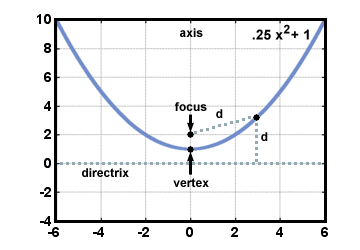
A parabola is a curve where any point is at an equal distance from:
|  |
citations:
Parabola Image- http://people.richland.edu/james/lecture/m116/conics/parabola.gif
shooting ball image- http://library.thinkquest.org/12006/images/parabola.gif
last image of parabola- http://www.sparknotes.com/math/precalc/conicsections/section2.rhtml
Subscribe to:
Posts (Atom)