Create your own Playlist on MentorMob!
Wednesday, December 12, 2012

Thursday, November 29, 2012
Wednesday, November 28, 2012
Student Problem #7 : Unit K Concept 10

- What is this problem about?
This picture covers a problem from Unit K Concept 10. This concept deals with writing repeating decimals as a rational number using geometric series. In this type of problem what you are basically trying to do is break down the decimal to discover the rational number or the sum of the decimal. After breaking down the decimal into repeating units you then are able to figure out the first term of the series and then the common ratio of the series which allows us to then plug it into the equation that has the sigma with the infinity sign. Then, you plug in a sub 1 and r into the summation notation formula in order to simplify and figure out the rational number.
- What does the viewer need to pay special attention to in order to understand the concept?
In order to understand the concept the viewer needs to pay special attention to how the decimal is broken down. What we do is basically take the repeating decimal and set it as its own. Then we out an addition sign which then allows us to break down the decimal by putting zeroes in front of the repeating decimal. The point of this is to make sure that you get the correct value for a sub 1. Also, when you have wrote out the series it is important that you write the broken down decimal correctly so that when we divide one term to the other, we and up with the correct common ratio (r).
Tuesday, November 27, 2012
Fibonacci Haiku
Fibonacci Haiku
Family
Love
My Foundation
My Support System
I will always love them
They are my motivation to do better everyday.

Fibonacci Haiku
Basketball
Perseverance
Hard Work
Passion to play
It is apart of me
Helps maintain the balance I need in life.

Sunday, November 4, 2012
Student Problem #6 Unit J Concept 6
 | |||||||||||||||||
Student Problem #6 Unit J Concept 6
This problem covers an example from Unit J Concept 6. This concept is very similar to Concept 5 except now we are dealing with Partial Fraction Decomposition with repeated factors. In this type of problem when you try in factor the denominator out you will find that one of the factors is repeated. Meaning that now when you separate the factor into separate equations for the repeated factor you must include the factor as a denominator as many times as the exponent. For example if the denominator as shown is (x-1)^3 you must have one fraction be A/(x-1), the nest one be B/(x-1)^2, and the last one be C/(x-1)^3. This is the only difference, then you would just solve as you did in concept 5.
|
Student Problem #5 Unit J Concept 5
 |
| Unit J Concept 5 |
- What is this problem about?
- What does the viewer need to pay special attention to in order to understand the concept?
Friday, October 19, 2012
Student Problem #4: Unit I Concept 2
 |
| Student Problem #4 Unit I Concept 2 |
- What is this problem about?
This problem goes over a real life example of a problem from Unit I Concept 2. Concept 2 deals with an example that is a logarithmic graph and by identifying it as that, we know that x=k and there are no restrictions on the range. Because it is a logarithmic graph we have a new equation in which we use: log base b (x-h)+k. Also, for this type of graph it is only important that we understand that the domain is dependent upon the asymptote.
- What does the viewer need to pay special attention to in order to understand the concept?
Wednesday, October 17, 2012
Student Problem #3 Unit I Concept 1:Graphing exponential functions
 |
| STUDENT PROBLEM#3 NOT ONE |
- What is the problem about?
- What must the reader pay close attention to in order not to make a mistake?
Thursday, October 11, 2012
Student Video #3: Unit H Concept 7
- What is this video about?
This video covers an example from Unit H Concept 7. Concept 7 is all about using what we have learned from previous concepts and applying them to another more complex problem, such as applying the knowledge we have of bringing one log together and then expanding it. We also use substitution in this concept when figuring out the expanded out log and plugging in the correct variable or number into the equation. In this lesson we also review how multiplication while solving logs, turns into addition. The main focus of this concept is to use the clues given to us to figure out the log given so that we can expand the log and substitute the values of the logs we expanded to form a new simplified equation.
- What does the viewer need to pay special attention to in order to understand the concept?
The viewer needs to pay attention to each of the steps taken to ultimately figuring out the correct solution to the problem of finding logs with clues. Also, to be successful in solving this type of problem we need to remember to use two of the log properties to add onto our list even though they are not written on the paper. We need to be responsible enough to remember to the two properties that are log base b of b= 1 and log base b of 1=0. These two properties are two extra clues that can be used to helps us figure out what to substitute once expanding the logs. In order to also understand the concept it is critical that you remember that the logs with fractions may need to be multiplied by a number on top or bottom so that one of the clues given can show up. In your ultimate answer there should not be a log it should be the values given when substituted.
Sunday, September 30, 2012
Unit G Summary Question 10: DIVAH range of a rational function
10. While the domain of a rational function depends on DIVAH, what do you thin k the range of a rational function depends on? Give an example.
While the domain of a rational function depends on DIVAH, the range of a function now depends on the horizontal asymptote. It depends on the opposite of what the domain does, the horizontal asymptote is what now determines the range of a rational function because it can go through the middle of the asymptote but never on the far left or right. This is the difference of domain and range because a vertical asymptote cannot pass through an asymptote while the horizontal can. For example, if there was a rational function and we were to graph it and it ended up going through the horizontal asymptote in the middle and contained a hole then that would give us a restriction for the range but sometimes it doesn't give us restrictions.

While the domain of a rational function depends on DIVAH, the range of a function now depends on the horizontal asymptote. It depends on the opposite of what the domain does, the horizontal asymptote is what now determines the range of a rational function because it can go through the middle of the asymptote but never on the far left or right. This is the difference of domain and range because a vertical asymptote cannot pass through an asymptote while the horizontal can. For example, if there was a rational function and we were to graph it and it ended up going through the horizontal asymptote in the middle and contained a hole then that would give us a restriction for the range but sometimes it doesn't give us restrictions.
Thursday, September 27, 2012
Unit G Summary Question 9: X-intercepts of a rational function
9. Describe how to find the x-intercept of a rational function. Include both the long way and the shortcut way, explaining when the shortcut makes mathematical sense.
Finding the x intercept for the rational function are very easy, you need to remember that for this equation you use the factored out function. We need to make sure we use the factored out equation when trying to find the x intercept because the original function is no longer really necessary. The long way of figuring out the x intercept you have to set the factored out function to 0 and then multiply it on both sides by the denominator. you then are able to set your numerator equal to zero to find the point. The shortcut method is also quite simple because all you need to do is set the numerator, of the factored out function, to zero. Either method should give you the same answer because it is the same thing just a new shorter way of figuring it out.

Finding the x intercept for the rational function are very easy, you need to remember that for this equation you use the factored out function. We need to make sure we use the factored out equation when trying to find the x intercept because the original function is no longer really necessary. The long way of figuring out the x intercept you have to set the factored out function to 0 and then multiply it on both sides by the denominator. you then are able to set your numerator equal to zero to find the point. The shortcut method is also quite simple because all you need to do is set the numerator, of the factored out function, to zero. Either method should give you the same answer because it is the same thing just a new shorter way of figuring it out.
Unit G Summary Question 6: Y- Value when its undefined
6. How do we find the appropriate place to plot a hole if the y-value is undefined when plugged into the original equation?
To find the appropriate place to plot a hole when the y value is undefined you have to plug it into the factored equation. When trying to find this exact spot we have to use the factored equation because if we use the original one it can result in a totally different answer. Since we have already factored out our function beforehand, we no longer bring into account the original one. All we need is the factored out rational function to find the rest of the stuff we need to find such as domain, x intercepts, and y intercepts. Its imperative that we don't pay attention to the original function as much because it can effect our answer.
To find the appropriate place to plot a hole when the y value is undefined you have to plug it into the factored equation. When trying to find this exact spot we have to use the factored equation because if we use the original one it can result in a totally different answer. Since we have already factored out our function beforehand, we no longer bring into account the original one. All we need is the factored out rational function to find the rest of the stuff we need to find such as domain, x intercepts, and y intercepts. Its imperative that we don't pay attention to the original function as much because it can effect our answer.
| |||||||||||||||
 .
.
Unit G Summary Question 5: Crossing through Assymptotes
5. Describe the conditions in which a graph can cross through an assymptote.
For each of the asymptotes there are conditions in which you know that they can or can't cross through a graph. In Horizontal asymptotes, graphs can sometimes cross the graph but only in the middle of the graph. The graphs can never cross at the far left or far right of the horizontal asymptote. Slant asymptotes also have the same conditions for the graph, they can cross but only towards the middle of the asymptote. As for vertical asymptotes, vertical asyptotes, the graph are never to cross the asymptote. To sum it up, Horizontal and slant asymptotes are able to have graphs that cross through there asymptote but vertical asymptotes should never cross ways!

For each of the asymptotes there are conditions in which you know that they can or can't cross through a graph. In Horizontal asymptotes, graphs can sometimes cross the graph but only in the middle of the graph. The graphs can never cross at the far left or far right of the horizontal asymptote. Slant asymptotes also have the same conditions for the graph, they can cross but only towards the middle of the asymptote. As for vertical asymptotes, vertical asyptotes, the graph are never to cross the asymptote. To sum it up, Horizontal and slant asymptotes are able to have graphs that cross through there asymptote but vertical asymptotes should never cross ways!
Vertical Asymptotes Never Cross!!!!
Wednesday, September 26, 2012
Student Video #1: Unit F Concept 10
By Kassie and Cecilia
- What is this video about?
This video covers an example from Unit F Concept 10. Concept 10 in this unit deals with us putting all the concepts together of this unit to ultimately figuring out the zeroes and the factorization of the polynomials. Such concepts included in this once concept are using the pq's, figuring out how many positive and negative real zeroes there are, and using synthetic division to figure out the zeroes. Also we are to now put the zeroes into there factored form so that we find the complete factorization of the polynomial. This video covers the complete process of concept 10 but also includes other practicing techniques of the same unit in this single problem.
- What does the viewer need to pay special attention to in order to understand the concept?
The viewer need to pay attention to each step we do so that they could ultimately figure out the correct answer. For example, you should not just blow off the pq's because when using synthetic division to find zeroes it is important that you limit your options so that you don't waste so much time trying to guess which numbers fit. In order to all understand the concept you must make sure that you pay attention to the detail and steps taken to figure out the right answer.
- What is this video about?
This video covers an example from Unit H Concept 7. Concept 7 is all about using what we have learned from previous concepts and applying them to another more complex problem, such as applying the knowledge we have of bringing one log together and then expanding it. We also use substitution in this concept when figuring out the expanded out log and plugging in the correct variable or number into the equation. In this lesson we also review how multiplication while solving logs, turns into addition. The main focus of this concept is to use the clues given to us to figure out the log given so that we can expand the log and substitute the values of the logs we expanded to form a new simplified equation.
- What does the viewer need to pay special attention to in order to understand the concept?
The viewer needs to pay attention to each of the steps taken to ultimately figuring out the correct solution to the problem of finding logs with clues. Also, to be successful in solving this type of problem we need to remember to use two of the log properties to add onto our list even though they are not written on the paper. We need to be responsible enough to remember to the two properties that are log base b of b= 1 and log base b of 1=0. These two properties are two extra clues that can be used to helps us figure out what to substitute once expanding the logs. In order to also understand the concept it is critical that you remember that the logs with fractions may need to be multiplied by a number on top or bottom so that one of the clues given can show up. In your ultimate answer there should not be a log it should be the values given when substituted.
Tuesday, September 25, 2012
Unit G Summary Question 8: Finding the y-intercept
8. How do you fin the y intercept of a rational function? Does this need to be done in the original or simplified equation?
Finding the y-intercept in a rational function is really simple. All you need to do is plug in zero into anywhere in which the equation has an x and simplify both on top and on bottom to get your y intercept.Finding the y intercept needs to be done using the factored out equation because sometimes the original equation contains x's on both top and bottom which means that it will be zero. But that is not correct, you need to use the factored out equation because yo get a complete different answer than when using the original function. Remember that there can only be one y intercept!

Finding the y-intercept in a rational function is really simple. All you need to do is plug in zero into anywhere in which the equation has an x and simplify both on top and on bottom to get your y intercept.Finding the y intercept needs to be done using the factored out equation because sometimes the original equation contains x's on both top and bottom which means that it will be zero. But that is not correct, you need to use the factored out equation because yo get a complete different answer than when using the original function. Remember that there can only be one y intercept!
Unit G Summary Question 7: Limit Notation for Vertical Asymptotes
7. Describe how to write limit notation for vertical asymptotes and what the notation means.
Vertical asymptotes deal with factoring and simplifying the rational function on both the numerator and the denominator. Once you have factored out the function you then set the denominator equal to zero so that you are able to figure out which numbers you are going to use to find the limit notation. For example, say you have factored out the bottom and set the factor of x+1=0, this will leave you with x= -1. With this number you will write out the notation like this: as x -> -1(to the right), f(x)-> either positive or negative infinity and you would also use as x-> -1 (to the left), f(x)-> either pos. or neg. The positive or negative depends on how your graph is to the right of the boundary line of negative 1 and how it looks to the left side of it. The notation lets us know whether that graph is in a positive or negative direction.

Vertical asymptotes deal with factoring and simplifying the rational function on both the numerator and the denominator. Once you have factored out the function you then set the denominator equal to zero so that you are able to figure out which numbers you are going to use to find the limit notation. For example, say you have factored out the bottom and set the factor of x+1=0, this will leave you with x= -1. With this number you will write out the notation like this: as x -> -1(to the right), f(x)-> either positive or negative infinity and you would also use as x-> -1 (to the left), f(x)-> either pos. or neg. The positive or negative depends on how your graph is to the right of the boundary line of negative 1 and how it looks to the left side of it. The notation lets us know whether that graph is in a positive or negative direction.
Unit G Summary Question 4: Vertical Asymptotes and holes
4. What s the difference between graphing a vertical asymptote and a graph having a hole?
When graphing rational functions, Vertical asymptotes and holes have a different function. A vertical function serves as a boundary line and is a guide for you to put your graphs in the specified spot. Holes are different, instead of being a boundary line, they are plotted as points on the graph to make your graphs a little more accurate. When dealing with a rational function that has a vertical asymptote you need to remember that you factor the function out as much as possible and then you are able to solve for your boundary lines. Another way of differentiating between the two is that the holes are a plotted point where the vertical asymptote is not.
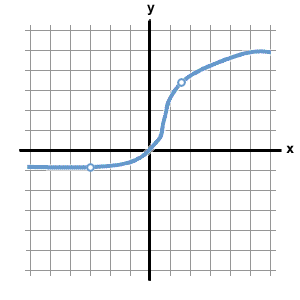
When graphing rational functions, Vertical asymptotes and holes have a different function. A vertical function serves as a boundary line and is a guide for you to put your graphs in the specified spot. Holes are different, instead of being a boundary line, they are plotted as points on the graph to make your graphs a little more accurate. When dealing with a rational function that has a vertical asymptote you need to remember that you factor the function out as much as possible and then you are able to solve for your boundary lines. Another way of differentiating between the two is that the holes are a plotted point where the vertical asymptote is not.
Unit G Summary Question 2: Limit Notation for Horizontal Asymptotes
2. Describe what limit notation for horizontal asymptotes actually means.
Limit notation is written so that we can identify the end behavior of a graph. The limit notation allows us to have a visual or guide to how the graphs would will look. In a horizontal asymptote the limit notation serves as a type of guide for the graphs. It tells you where the horizontal y axis is just as a fact of how the behaviors are when approaching positive and negative infinity. More specifically, it lets you know if the graph is heading towards the number given.
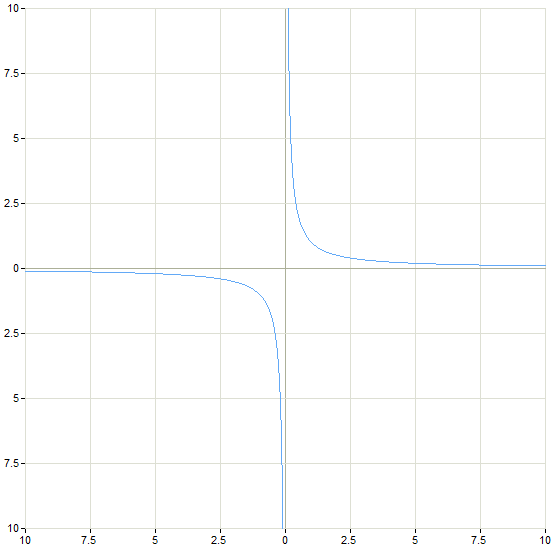
Limit notation is written so that we can identify the end behavior of a graph. The limit notation allows us to have a visual or guide to how the graphs would will look. In a horizontal asymptote the limit notation serves as a type of guide for the graphs. It tells you where the horizontal y axis is just as a fact of how the behaviors are when approaching positive and negative infinity. More specifically, it lets you know if the graph is heading towards the number given.
Sunday, September 23, 2012
Unit G Summary Question 3: Slant Asymtote
3. When does a graph have a slant asymptote? How do you find the equation of a slant asymptote?
A slant asymptote is a line that is slanted and either goes uphill or downhill. A slant asymptote only exists if the degree of the top is ONE bigger than the degree on the bottom. To locate aslant asymptote you must perform long division. After performing long division everything but your remainder is now the equation of the slant asymptote of the line. To find the equation you also use y=mx+b. Something to remember about slant asymptotes is that the graphs can sometimes cross through towards the middle of the graph.
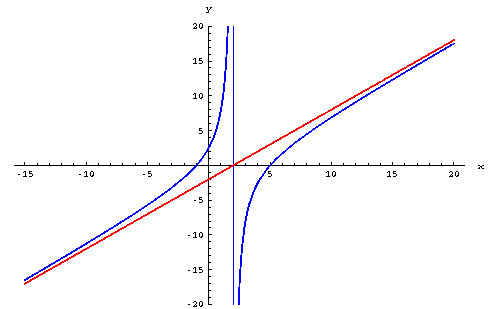
A slant asymptote is a line that is slanted and either goes uphill or downhill. A slant asymptote only exists if the degree of the top is ONE bigger than the degree on the bottom. To locate aslant asymptote you must perform long division. After performing long division everything but your remainder is now the equation of the slant asymptote of the line. To find the equation you also use y=mx+b. Something to remember about slant asymptotes is that the graphs can sometimes cross through towards the middle of the graph.
Unit G Summary Question 1: horizontal asymptotes
1. How do we know if a graph has a horizontal asymptote? What are the three options?
A horizontal asymptote would jut be a horizontal dotted line. To figure out the horizontal asymptotes you have to compare the degrees of the numerator and the denominator. The first option will be if the bigger degree is on the bottom the asymptote will be y=0. Second, if both the numerator and denominator have the same degree then the asymptote is the ratio of the coefficients. But, if there is a bigger degree on top, there will be no asymptote. One thing we got to remember about horizontal asymptotes is that graphs can sometimes cross through them but only towards the middle not to the far left or right.

A horizontal asymptote would jut be a horizontal dotted line. To figure out the horizontal asymptotes you have to compare the degrees of the numerator and the denominator. The first option will be if the bigger degree is on the bottom the asymptote will be y=0. Second, if both the numerator and denominator have the same degree then the asymptote is the ratio of the coefficients. But, if there is a bigger degree on top, there will be no asymptote. One thing we got to remember about horizontal asymptotes is that graphs can sometimes cross through them but only towards the middle not to the far left or right.
Subscribe to:
Posts (Atom)